

I see it all the time. Someone hits a pothole on the way to work or slides into a curb in a parking lot, and they figure, “It drives fine. I’ll deal with it later.” And then a few weeks go by. Maybe a month. Tires start getting louder, the ride feels rough, and all of a sudden, they are shopping for new tires way earlier than they expected.
At HCS Auto Repair, we have been a part of Rogers since 1988. Since moving to our current location in 2013, we’ve helped a lot of local drivers sort out the same problem: a quick hit that didn’t seem like a big deal, but it quietly knocked the suspension or alignment out of spec.
And yeah, I get it. Potholes are everywhere in some seasons. Curbs are sneaky. You turn in a little too tight, the back tire catches the edge, and you feel that sideways bump. It happens fast.
The bigger issue is what happens after.
The pothole debate: swerve or take it straight?
Get this question a lot, mostly after the incident. Do you veer to avoid the pothole, or do you simply drive through it, pausing for a moment? I won’t claim there is one right answer applicable in every scenario. I cannot picture the environment around your vehicle at that instant. If you swipe the steering to bypass the pit and then endanger another person, that won’t be a victory.
Sometimes the restoration of a vehicle is a better result than a mishap. The main point I can make, with assurance, is that if you potholed your car badly, or you lost control and rode the curb, you ought to think that the balancing of your wheels may have been altered. A minor deviation can make a difference. And you won’t always feel it right away.
Why alignment problems sneak up on you
A lot of drivers only think about wheel alignment when the steering wheel is pulling hard to one side. That’s the obvious sign. But alignment can be off without a dramatic pull, especially at first.
The reason for the problem is as follows. Tire prices are on the rise every year. One of the major reasons for the tires to last longer is that the alignment has to be good, and regular checks for it have to be done. Poor alignment can make the tire roll in an uneven manner, which is not the way it is meant to roll. It scrubs. It drags. It wears on the inside edge or the outside edge, and you may not notice until the wear is already deep.
Once that uneven wear pattern starts, you can’t “undo” it. Even if we correct the alignment later, the tire has already been shaped by that bad angle. It will keep wearing weird, and it will often stay noisy. That’s the part that really stings for people. They come in hoping an alignment will save the tire. Sometimes it will slow the damage, sure. But if the tire is already worn down on one side, that tire is never going to be perfect again.
So the timing matters. A lot.
What tire wear can tell me, even before you feel anything?
I like using tire wear as a clue because tires tell the truth. If a tire has an uneven feel, kind of choppy or wavy as you run your hand across the tread, that often points to issues beyond alignment.
One common pattern is called chopping or feathering. You can sense this roughness, as if the tread blocks are unevenly worn. This occurrence is the outcome of improper control of the bounce by shocks or struts. The tire is literally getting a beating while rolling, bouncing, and slapping the road instead of being planted.
Up until now, improper alignment will most likely present itself as the inner edge wearing down or the outer edge wearing down more than the rest. A lot of people don’t look at the inside edge of their tires. They glance at the outside, and it looks okay, and they move on. Meanwhile, the inside edge is getting eaten up.
That’s why I’m a fan of checking alignment on a schedule, and also checking it right after a big impact.
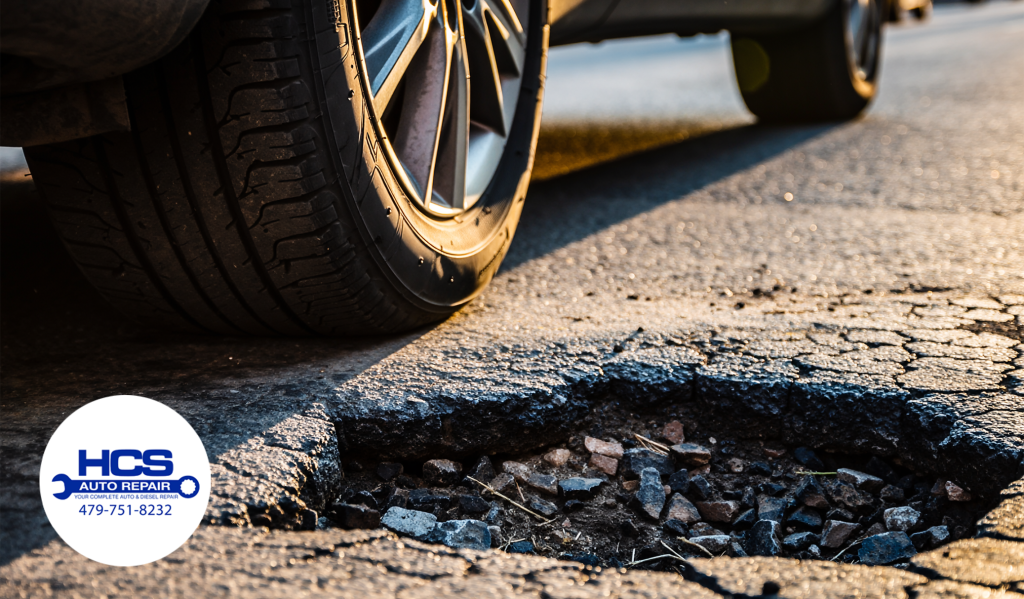
After a pothole or curb hit, waiting can cost you tires.
Here’s the rule I live by in the shop: when you hit a good, hard pothole, or you bump a curb sideways, it’s smart to get the alignment checked soon. Not after the tire starts looking bald. Not after the steering wheel is clearly crooked. Right then.
It’s not about being dramatic. It’s about preventing the problem while it’s still preventable.
An alignment check is usually cheaper than a tire. And it’s definitely cheaper than a full set of tires. Plus, if something else is bent or loose, we can catch it early before it causes a chain reaction.
A lot of suspension issues start small. A minor bend. A part that got stressed. A bushing that started tearing. If you keep driving, it can turn into faster tire wear, vibration, noise, and more wear on other components. That’s when the repair grows up into something bigger.
Shocks and struts: the tire killers people forget about
Even if your alignment is perfect, your tires can still get destroyed if your shocks or struts aren’t doing their job.
The main purpose of shocks and struts is to restrain the vehicle’s movements. Each time the wheel gets over a bump or down into a hole, the whole suspension system goes through the process of compression and rebound. A well-functioning shock or strut takes the bouncing of the suspension and lets the wheel come back to the ground in a slow and smooth way, thus keeping the tire on the road.
The failings of a shock or strut cause the tire to bounce more than usual. This bounce is one of the reasons for the choppy wear mentioned earlier. It can also result in the car being slippery, unsteady, or harsh to ride on during bumps. And here’s a very easy, practical check we do all the time.
If you see oil on the shock or strut, it’s time.
Shocks and struts have internal chambers filled with fluid. If you see oil leaking on the outside of the shock or strut body, that’s not a “keep an eye on it” situation. That’s a replacement situation.
Once it’s leaking, it can’t hold the weight and control motion the way it’s supposed to. The fluid is part of how it dampens movement. No fluid, no proper damping.
The scary part: a fully worn strut can cause bigger damage
When a strut is completely shot, you may hear clunking or banging when you go over bumps. If you hear that, don’t wait. That’s the kind of symptom that can go from annoying to expensive, fast.
At the extreme end, a failed strut can damage mounting points. The mounts can tear, and then you’re not just replacing a strut. You can get into more major repair work because the vehicle structure, where it mounts, can be affected. That’s the part most people don’t realize. They think it’s “just a noise.”
It’s not always just a noise.
What a good strut feels like (and why it matters)
A good strut takes effort to compress. When it rebounds, it comes back up slowly. The controlled motion is what guarantees the longevity of your tires and the stability of the whole vehicle. In case of any of the following symptoms: bouncy ride, continuous floating after a bump, noise from clunking, or oil dripping on the struts, then it is high time to check it. Tires are quite expensive; thus, it is not worth the risk.
How often should I check alignment and suspension?
For most drivers, I like alignment checks every 6 months to a year. If you drive on rough roads a lot, commute daily, or you’ve had a recent pothole or curb hit, it’s smart to be on the shorter side of that.
And suspension checks should be routine, too. This is one reason I prefer having a real technician look your car over, not just a quick oil change stop. When we do an inspection, we’re watching for leaks, worn parts, looseness, and early signs that something is starting to fail. That’s how you avoid surprises.
I’m not saying every pothole needs a repair. I’m saying impacts can knock things out of spec quickly, and the cost of ignoring it is usually paid in tires.
A quick list of signs I want you to take seriously
- After a pothole or curb hit: steering wheel off-center, pulling, new vibration, or the car feels “different” even if you can’t explain it.
- Ongoing signs: uneven tire wear (inside or outside edges), choppy or feathered tread feel, clunking over bumps, or visible oil on shocks/struts
That’s it. Simple signs, but they matter.
FAQ: Potholes, curbs, alignment, and suspension
Can one pothole really ruin my alignment?
Yes, a hard pothole hit can knock alignment out, especially if you hit it at speed or with a front wheel. It doesn’t always create a dramatic pull right away, but it can start uneven tire wear quickly.
If my car drives straight, do I still need an alignment check?
Not always, but “drives straight” doesn’t guarantee alignment is perfect. Slight misalignment can still wear tires. If you hit a pothole hard or bump a curb sideways, I recommend checking it soon.
What happens if I wait too long to fix alignment?
The tires start wearing unevenly. Once that wear pattern is established, correcting alignment won’t restore the tire. The tire will often wear poorly and may stay noisy.
What does feathering or chopping on a tire mean?
Most of the time, it feels choppy when you run your hand across the tread. Such discomfort may be a sign of shocks or struts that are not properly controlling bounce; however, at the same time, there might be other suspension problems that are also causing the situation.
What is the method I can use to tell if my shocks or struts are bad?
In case you see oil leaking from the shock or strut, that is the most evident sign that the component is not working correctly. Other noise signs comprise driving over bumps, a bouncy ride, and uneven tire wear. How frequently should I have my alignment checked? The guideline is every 6 months to a year, also any time after hitting a pothole hard or impacting the curb.
Don’t wait until the tires are already ruined.
I’d rather see you right after the pothole hit than months later when the inside edges of your tires are shredded, and the fix gets more expensive. Alignments and suspension checks are preventative work that actually pays you back, because they protect your tires and help your car feel right again.
If you hit a pothole hard, bumped a curb, or you’re noticing uneven wear, pulling, or clunking over bumps, call HCS Auto Repair in Rogers, AR at (479) 751-8232 and let us take a look before it turns into a bigger problem.
image-filename: dont-wait-pothole-curb-hit-ruins-alignment-fast.md