

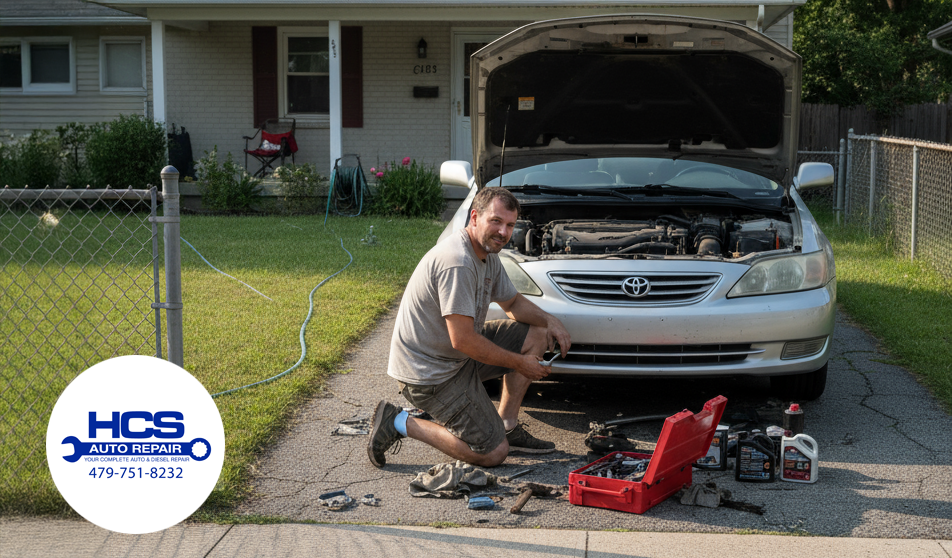
It can be a great pleasure to do car repairs yourself; rolling up your sleeves and getting in there to solve that persistent problem! First, you may feel fulfilled to know you can save money, acquire skills that can come in handy later, and even know the inner workings of your car better. Better yet, the auto repair community of DIYers provide online resources that make it easier to fix your vehicle at home more than ever before.
But the truth is that if you do not know intimately what you are doing when you work on your car, you could possibly make an inexpensive repair turn into a very costly nightmare very quickly. What was once a project that was easier on your budget can easily become a situation of severe damage, a risk of fire, or the worst case, the death of someone later on the road! The success or failure of a DIY repair often relies on the ability to prevent the common errors that even the most experienced home mechanics make.
At HCS Auto Repair, our ASE-certified technicians have seen it all since 1988. We’ve helped countless Springdale residents recover from well-intentioned DIY attempts gone wrong. The good news? Most of these costly mistakes are completely preventable when you know what to watch out for (after certification training and several years of experience.) Let’s dive into the seven most common DIY mechanic mistakes that could cost you time, money, and peace of mind!
1. Improper Vehicle Jacking Techniques
One of the most dangerous DIY mechanic mistakes involves improper jacking techniques. Your vehicle has specific reinforced jacking points designed to handle the weight safely. These reinforced areas appear as ridges along the body, but here’s what many people miss: there are only two designated spots on each side of your car- one at the front and one at the rear.
Placing your jack anywhere else along that ridge puts pressure on thinner metal called the pinch weld, which can bend under your vehicle’s weight. This car repair safety issue can damage your car’s body and cause your jack to slip unexpectedly.
The risk increases dramatically when working on higher vehicles. You might be tempted to position your jack under seemingly sturdy components like:
- Control arms (which often become slanted as the vehicle lifts)
- Leaf springs
- Other angled suspension parts
These slanted surfaces create unstable jacking conditions where your jack can slip out sideways, potentially dropping the vehicle on you. This represents one of the most serious auto repair problems you can encounter. Always verify you’re using a flat, designated jacking point before lifting your vehicle. Your safety depends on it.
2. Mistakes When Purchasing Replacement Parts
Buying car parts can feel like navigating a minefield when you’re tackling DIY mechanic errors. You’ve probably experienced this: you enter your vehicle’s year, make, and model into an online catalog or tell the parts store clerk your information, then assume the system will deliver exactly what you need. Here’s the reality- catalogs get it wrong sometimes, and that mistake doesn’t reveal itself until your car is completely torn apart in your garage.
The Problem with Trusting Automated Systems
The problem starts with blind trust in automated systems. These databases aren’t perfect, and they occasionally list incorrect parts for specific vehicle configurations. User error compounds the issue. Your registration might show one year, but your vehicle could have been manufactured the previous year, leading you to order the wrong component entirely.
How Visual Confirmation Can Help
Visual confirmation saves headaches. Prior to hitting the “purchase” button or leaving the parts counter, take a picture of the part you are removing. If it is convenient, such as an alternator or power steering pump, a quick picture will provide you with a point of reference for the new part. It’s even better if you take the old component out first when you can. Coming to the store with the genuine part in your hand allows you to put them next to each other and make sure that you are getting the exact match.
The Temptation of Cheap Auto Repair Parts
The temptation to buy the cheapest auto repair parts online is strong- we get it. Aftermarket parts flood the market at bargain prices, and sometimes they’re perfectly adequate. A windshield washer reservoir or basic coil won’t break the bank if it fails prematurely. The calculation changes dramatically for critical components.
When Cheap Parts Become Expensive Mistakes:
Timing belt kits – Engine damage from failure costs thousands
Water pumps – Deep inside the engine, requiring extensive labor to access
Fuel pumps – Dropping the fuel tank twice isn’t anyone’s idea of fun
The Value of OEM Parts
OEM (Original Equipment Manufacturer) parts cost more upfront, but they’re engineered specifically for your vehicle. They last longer, fit correctly the first time, and won’t compromise engine safety. If the repair job requires dismantling half your engine bay, spending extra on OEM parts means you won’t be doing that same job again in six months.
The Golden Rule of Part Replacement
The golden rule? Do not forget to make a comparison of the old and new parts prior to the installation. Bolt hole patterns, connector configurations, and mounting brackets can slightly differ among manufacturers. Realizing these differences when you are already under the hood, trying to fit an incompatible part into place, is very frustrating and is considered one of the worst experiences in DIY repair.
3. Mistakes with Battery Handling During Repairs
It is necessary to pay close attention to battery safety when dealing with the car’s electrical system. One of the most serious DIY auto repair mistakes is definitely forgetting to disconnect the battery before working on the electrical parts. When starters or alternators are being replaced, these components are directly linked to the positive terminal. So, if you keep the battery connected and your wrench accidentally touches the engine block, you will cause a dangerous short circuit, which will produce sparks and possibly damage costly components.
The proper disconnection sequence matters just as much as remembering to disconnect at all:
- Always remove the negative terminal first (remember: eliminate the negative, keep the positive)
- The negative terminal connects to your entire vehicle’s frame, making it the ground for the electrical system
- Removing the positive terminal first risks creating sparks if your wrench contacts any metal surface
- Once the negative terminal is off, the electrical system is safely disconnected
The fact that battery terminals are tapered is one of the reasons why this mistake is the most common among ignorant people. A loose connection will cause all sorts of electrical problems that will annoy you in the future if you just tighten the clamp while it’s sitting on top of the post. Loosening the clamp fully, pushing it down to the base of the battery post, and then tightening it securely is the right technique. This mechanical tip, simple as it is, prevents the intermittent electrical problems that often occur with DIY repairs and keeps you from making one of the seven common DIY mechanics mistakes that could cost you both time and money.
4. Neglecting Diagnostic Scan Tools for Accurate Troubleshooting
If you’re serious about DIY car diagnostics, relying on free scans at auto parts stores just won’t cut it. Sure, those quick code reads work for simple one-off issues, but they only give you a snapshot of what’s wrong. You miss out on the real power of scan tool use– live data monitoring.
The investment in a decent scanner with live data capability saves you countless hours and gas money. You don’t need to drop hundreds on a professional-grade unit- just make sure whatever you buy includes that live data feature for effective car diagnostics. Be prepared, as learning to use it properly is the next big step!
5. Ignoring Wheel Alignment After Suspension or Steering Repairs
You can easily make suspension repair mistakes and steering alignment oversights, which are among the most expensive DIY errors that you can make. When you change parts such as lower control arms, upper control arms, outer tie rods, or inner tie rods, the alignment of your tires is affected directly in terms of direction and angle. All these components have features allowing adjustments for the wheel positioning to be made.
Skipping the alignment step leads to serious issues:
Dangerous handling problems – Your car might actively pull you off the road while driving on the highway
Uneven braking – The vehicle could brake unpredictably, creating dangerous situations
Premature tire wear – You’ll go through expensive tires much faster than normal
Before taking apart any steering or suspension components, grab a marker and carefully mark how everything lines up. Take photos from different angles. These reference points help you put components back together in nearly the same position, keeping your alignment close to its original settings. This method won’t replace a professional alignment, but it prevents your car from becoming dangerously out of spec when you finish the job.
6. Incorrect Nut and Bolt Handling Techniques
It might look simple to work with nuts and bolts; nevertheless, fastener mistakes are still among the most frequent DIY mechanic errors we claim at HCS Auto Repair, and the consequences can be from frustrating to very costly.
Overtightening: The Hidden Danger
Overtightening is a hidden danger that can create problems during engine repairs. For instance, valve cover bolts- these little 10mm bolts don’t require a lot of torque, yet many home mechanics tighten them as if more is better. What can happen? Bolt heads snap, or the threads in your aluminum engine head get stripped. If you break a bolt off on the side of your engine, then you might have to take out the whole motor just to be able to drill it. That repair bill turned from a simple job to a nightmare.
Under tightening: A Recipe for Disaster
The reverse issue (undercutting) has its own problems to present. Loose fasteners along the oil pans, valve covers, or coolant passages can eventually leak, and this can harm your engine or leave you in trouble.
Cross-Threading: A Costly Mistake
Cross-threading occurs when a bolt or nut is being forced on at the wrong angle. Lug nuts are specifically known for this- people start them off crooked and then use an impact wrench to force them on, thus breaking the wheel stud that is inside the lug nut. Now you will have to remove the wheel, caliper, and rotor just to be able to put that broken stud back.
The Fix: Simple Yet Effective
Always hand-start your bolts first. They should thread on smoothly with just your fingers. If you feel resistance, back it out and try again. For smaller fasteners, get them snug, then add about a quarter turn. When you’re unsure, a torque wrench eliminates the guesswork and prevents these 7 common DIY mechanics mistakes that could cost you from happening in the first place.
7. Investing in Quality Tools Versus Cheap Alternatives
That $5 socket set from the discount bin might seem like a steal, but tool quality problems can turn a simple repair into a nightmare. Picture this: you’re halfway through removing your alternator when your cheap ratchet snaps, leaving you stranded mid-job. You’ll either need to make an emergency trip to buy a replacement or awkwardly ask your neighbor to borrow theirs.
Smart mechanic tools investment means prioritizing your spending:
Go quality on basics: Your everyday hand tools- wrenches, ratchets, sockets, and pliers- deserve your investment. These workhorses need to withstand regular use without letting you down.
Budget-friendly specialty items: Tools you use occasionally, like a basic voltmeter for simple electrical checks, don’t require premium pricing. A $10 meter that handles basic functions beats a $400 professional model when you’re only checking battery voltage twice a year.
Game-changing additions: Some DIY car repair tools punch above their weight class. The right-angle needle-nose pliers can easily reach around hoses and behind components in tight engine bays that are inaccessible to regular pliers. The use of ratcheting box wrenches means you don’t have to go through the turning-removing-resetting cycle all the time, which saves you minutes, if not hours, of working time in the tight spaces. These specialized tools are not that “essential,” but they definitely will save your sanity during difficult jobs.
Choose HCS Auto Repair
Repairing your own car can be a huge source of satisfaction, but the ability to know when to ask the pros for help makes all the difference. The seven mistakes that we have discussed above, as common as these mistakes are, could all end up turning into expensive repairs, putting your safety at risk, and suffering through hours of frustration. This is where establishing a partnership with a reliable auto repair shop becomes an absolute necessity.
At HCS Auto Repair, we have a team of ASE-certified technicians with many years of experience for every job. Since 1988, we have been providing the people of Springdale, AR, with quality auto service that is always up to date, and we have understood that your professional mechanic support, along with your DIY enthusiasm, will definitely result in the best outcomes for your car.
No matter if you want to get a second opinion before going for a complicated repair, alignment after replacing suspension parts, or an expert diagnostic to indicate the right way, we are always ready to assist. Do not allow common mistakes to spiral out of control and turn into expensive nightmares.
Do you want to ensure your vehicle’s safety and performance? Call us at (479) 751-8232 for an appointment today. Your vehicle is worth the best servicing, and so are you, concerning having no worries.